Art Talk (2026)
Open studio art talk for Moku / MANGO about my current creative process. Please see the program from residency here: NUESTRA TIERRA. My pieces and all the pieces from previous iterations of the residency can be seen here: Our Land Exhibition
Installation of "Crane Chorus Dawn (Sonic Origami)" (2026), image of print
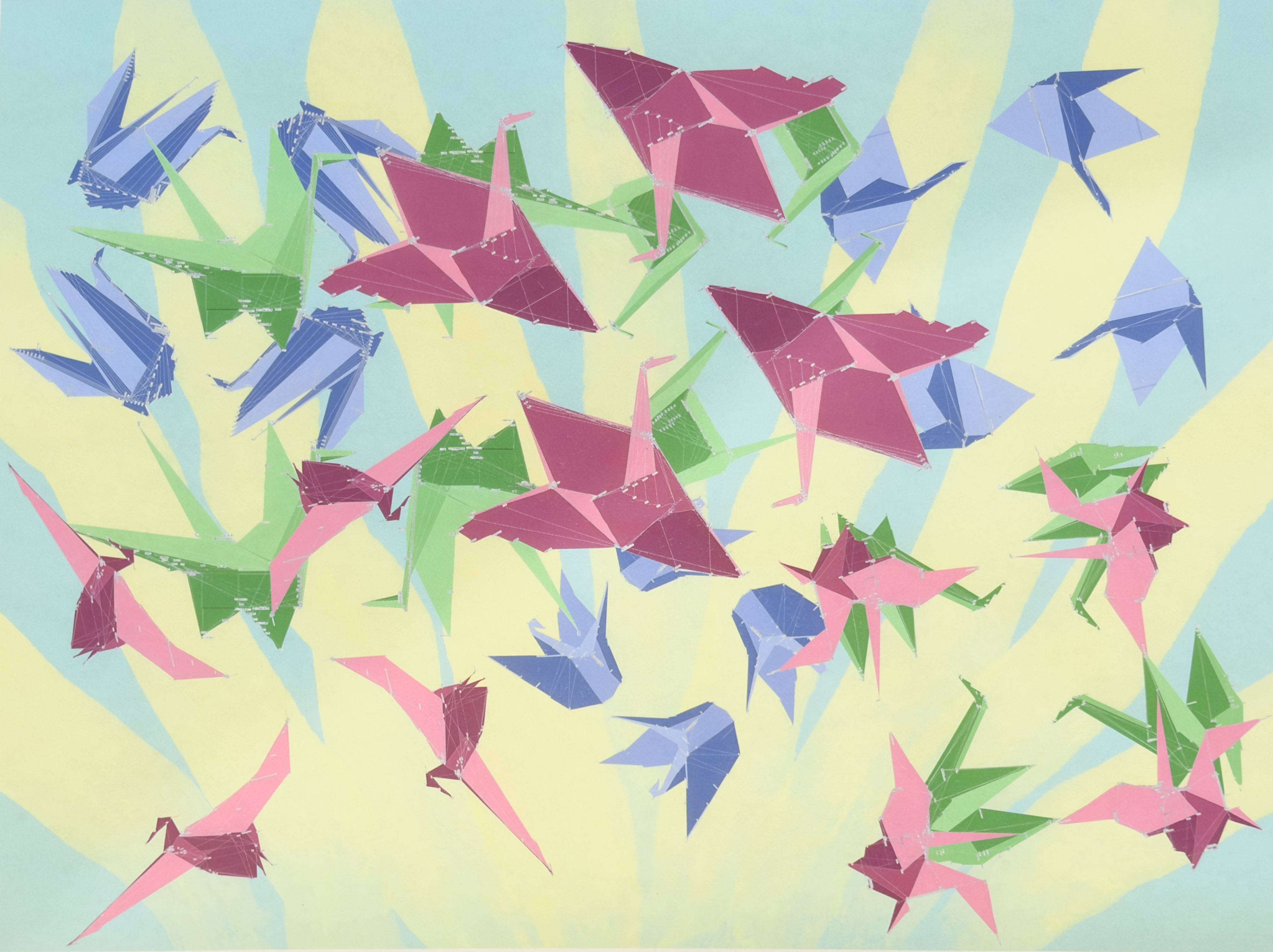
12x16in | kozo paper print | integrated audio hardware | digital audio. "Crane Chorus Dawn (Sonic Origami)" is a multilayered exercise in transformation developed for the Moku/MANGO "Our Land" residency. This iteration of the work is an installation of that piece. It is a 12-by-16-inch digital print on kozo paper mounted within a custom frame equipped with integrated audio hardware. It acts as an installation and performance of the "Crane Chorus Dawn" score. See the digital version here: https://youtu.be/f9m2RXAHvC4
Crane Chorus Dawn (Sonic Origami) (2026), hires image
4500x6000px | plugdata and field recording | video. This project utilizes a practice I have developed called “sonic origami”. Nine Plugdata signal processing diagrams are shaped into paper cranes, tessellated, and arranged into a visual composition. Each depicted crane functions as a synthesizer, employing band-pass filters to deform the broad-spectrum noise of rustling paper into specific crane calls recorded at Whitewater Draw. This mimics, in the sonic realm, the traditional practice of folding paper into cranes. The composition triggers these networks to produce 999 synthesized crane calls, which are intermixed with field recordings of cranes and rustling paper. In Japanese folklore, folding 1,000 paper cranes grants a wish—a mastery of deformation that manipulates reality itself. By stopping at 999, the work brings the listener to the very edge of world transformation. This work was developed during the "Our Land" residency, a collaboration between Moku Art Studio (USA) and MANGO (Argentina). See the installed version here: https://youtu.be/G49yiclmd2o
Whitewater Cranes (2026), hires image

10000x6000px | plugdata and field recording | video. Plugdata is a visual programming language for manipulating audio through signal diagrams. Whitewater Cranes is a piece in a running series of musical compositions created in plugdata networks which are then reshaped into pieces of digital art. (As shown in the Border Signals Exhibit, though, these digital pieces can take physical form.) The composition depicted in Whitewater Cranes was performed live at the Plein Air installation organized by Robert Henderson and Johanna Skibsrud. It includes field recordings of Sandhill cranes, digital instruments built out of those field recordings, and the input from a 70-foot tape loop run en plein air containing recordings of poems composed by visitors to the Border Signal Exhibit (2025).
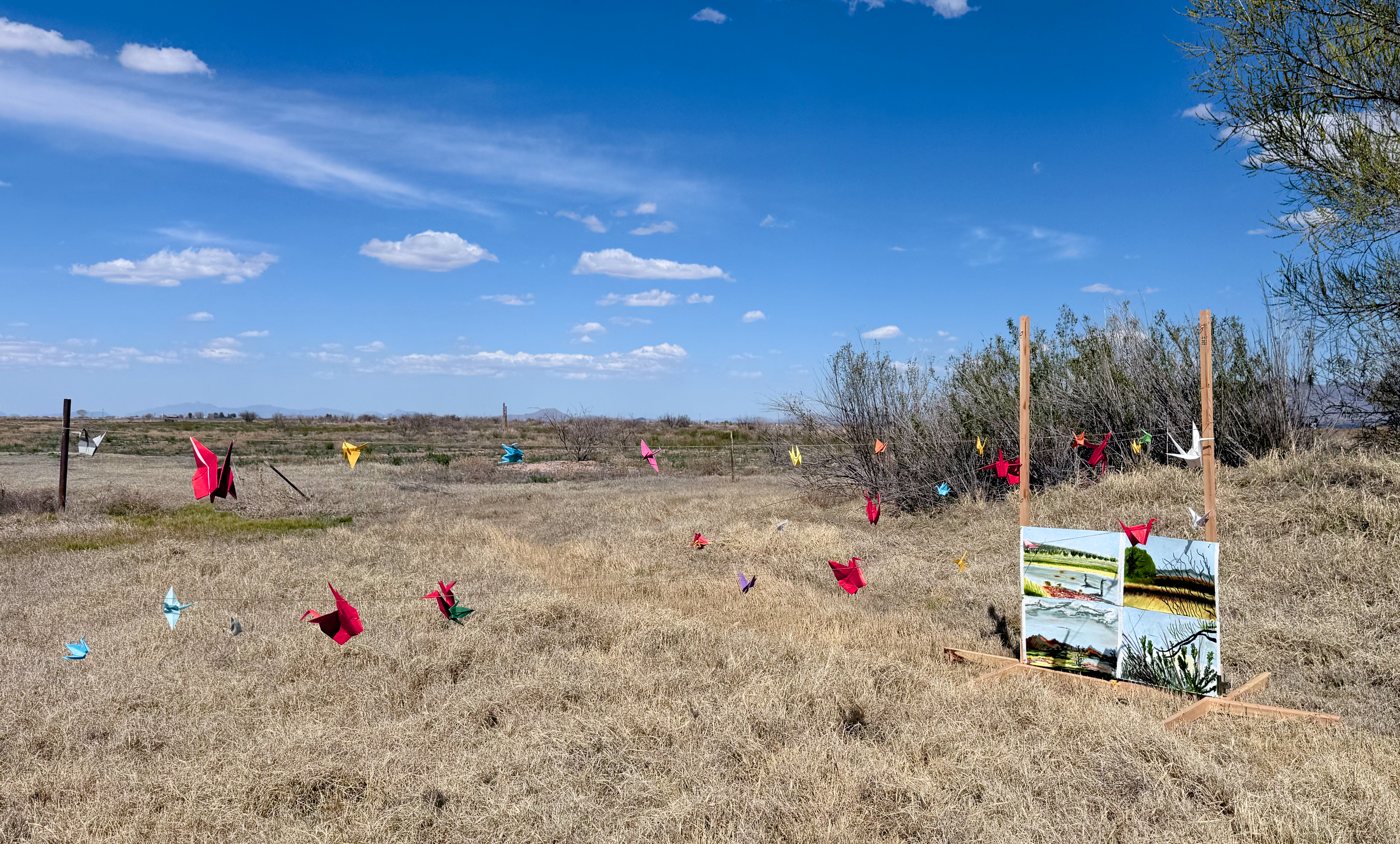
"Plein Air" Installation (2026)
Plein Air was a site-specific workshop and installation organized by Robert Henderson and Johanna Skibsrud on March 8th, 2026, at Whitewater Draw, the winter home of the migratory Sandhill crane. Plein Air was the next iteration of Skibsrud's Lines of Flight, incorporating a tape of poetry recorded at Border Signals (2025). At that exhibit, visitors were asked to spend time listening to the sonic landscape of the paintings and to write down 10-15 words of what they overheard. Finally, they were invited to create from what they’d written a short poem that would also serve as possible response to the questions or problems they had identified as implicit in the work, and to record their poem on a tape recorder provided by the door. In Plein Air, we began in the material, with a tape, a ribbon bearing sonic information, and asked how to bring that out of the gallery and into the landscape of the border region. The answer conceived was to install a tape loop en plein air. This would allow engagement with both aspects of tape as an object. In terms of materiality, tape is something that can be extended in space. At the same time, as an information-bearing object, the spatially extended tape could be played as part of musical composition.
The installation began with a plein air painting workshop centered on perspective. Eight designated painters, grouped in fours with matching materials, were directed to paint scenes framed in twine stretched between wooden supports. Since the painters stood at various distances and angles relative to their twine-framed picture planes, the resulting pieces diverged from classical western landscape perspective, and even moreso once each group assembled their paintings into a unified multiperspectival scene representing their sum view.
These composite paintings were hung between the wooden supports along with garlands of paper cranes made by participants in the workshop. Then, as a group we, ran the Border Signals poetry tape through slashes cut in the paintings to form a 70-foot loop. The tape was played, its sound modulated by the wind and the many hands shepharding it through the installation. The playback was incorporated into a live performance of a composition by Henderson, which also includes field recordings of Sandhill cranes and digital instruments built out of those field recordings.
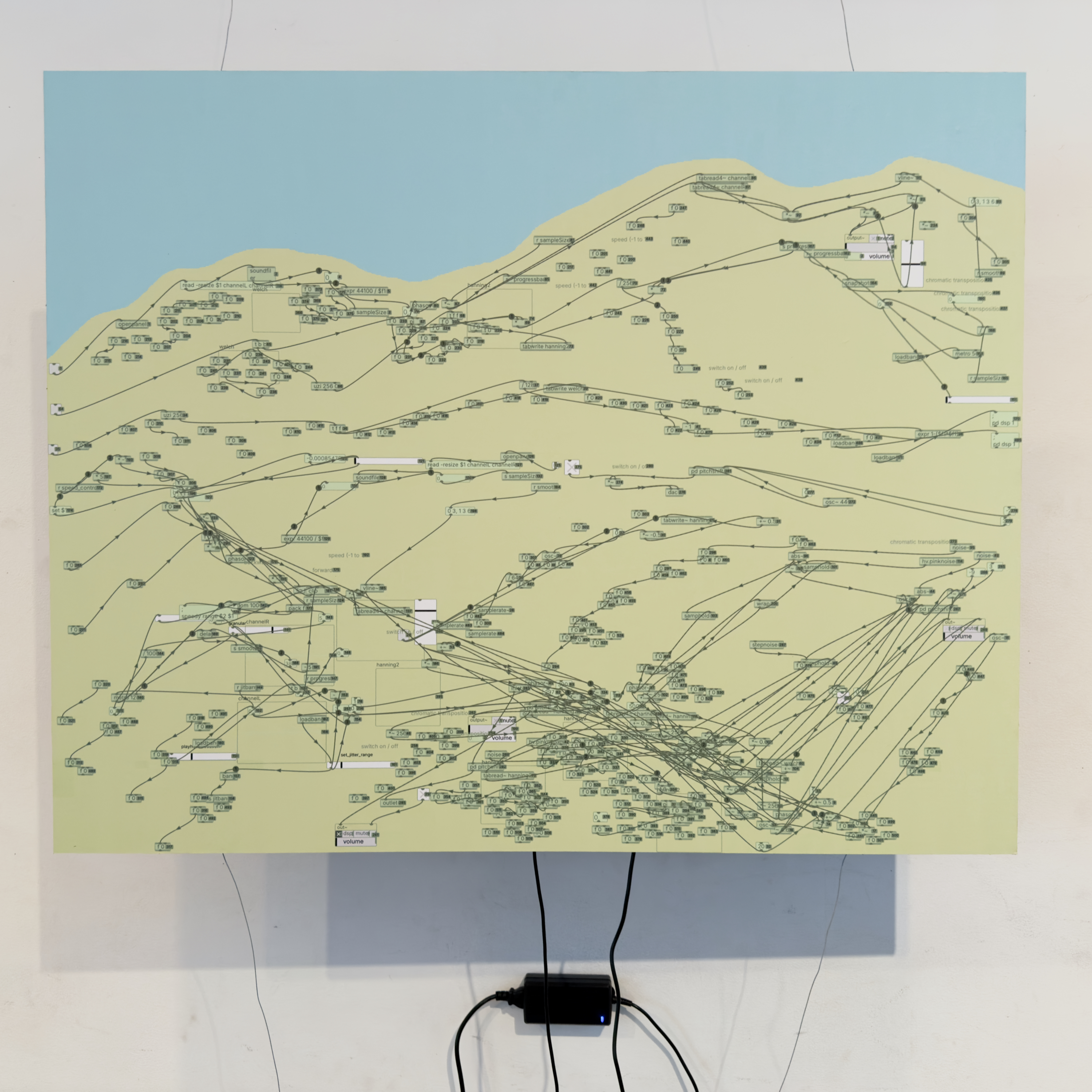
40x32 | multimedia | Desert Signal (2025)
Installed as part of the Border Signals Exhibit at Wave Archive (October 2 to October 19, 2025), Desert Signal functions as a sonic and visual topography of the borderlands, specifically depicting the desert landscape at a site-specific installation close to the wall in Nogales. The image is a functioning Plugdata signal-processing diagram shaped to represent the terrain's physical contours. This diagram modulates field recordings taken during the event. Equipped with electronics on the verso, and hung from the ceiling with wire, the rigid surface is vibrated by transducers, serving as the speaker for the audio generated by the visible diagram.

30x40 | multimedia | Tower Signal (2025)
Installed as part of the Border Signals Exhibit at Wave Archive (October 2 to October 19, 2025), Tower Signal functions as a sonic and visual reconstruction of border infrastructure, specifically depicting Integrated Fixed Towers close to the border wall in Nogales. The image is a functioning Plugdata signal-processing diagram shaped to represent the towers' physical forms. This diagram modulates field recordings taken during a site-specific installation. Equipped with electronics on the verso, and hung from the ceiling with wire, the rigid surface is vibrated by transducers, serving as the speaker for the audio generated by the visible diagram.
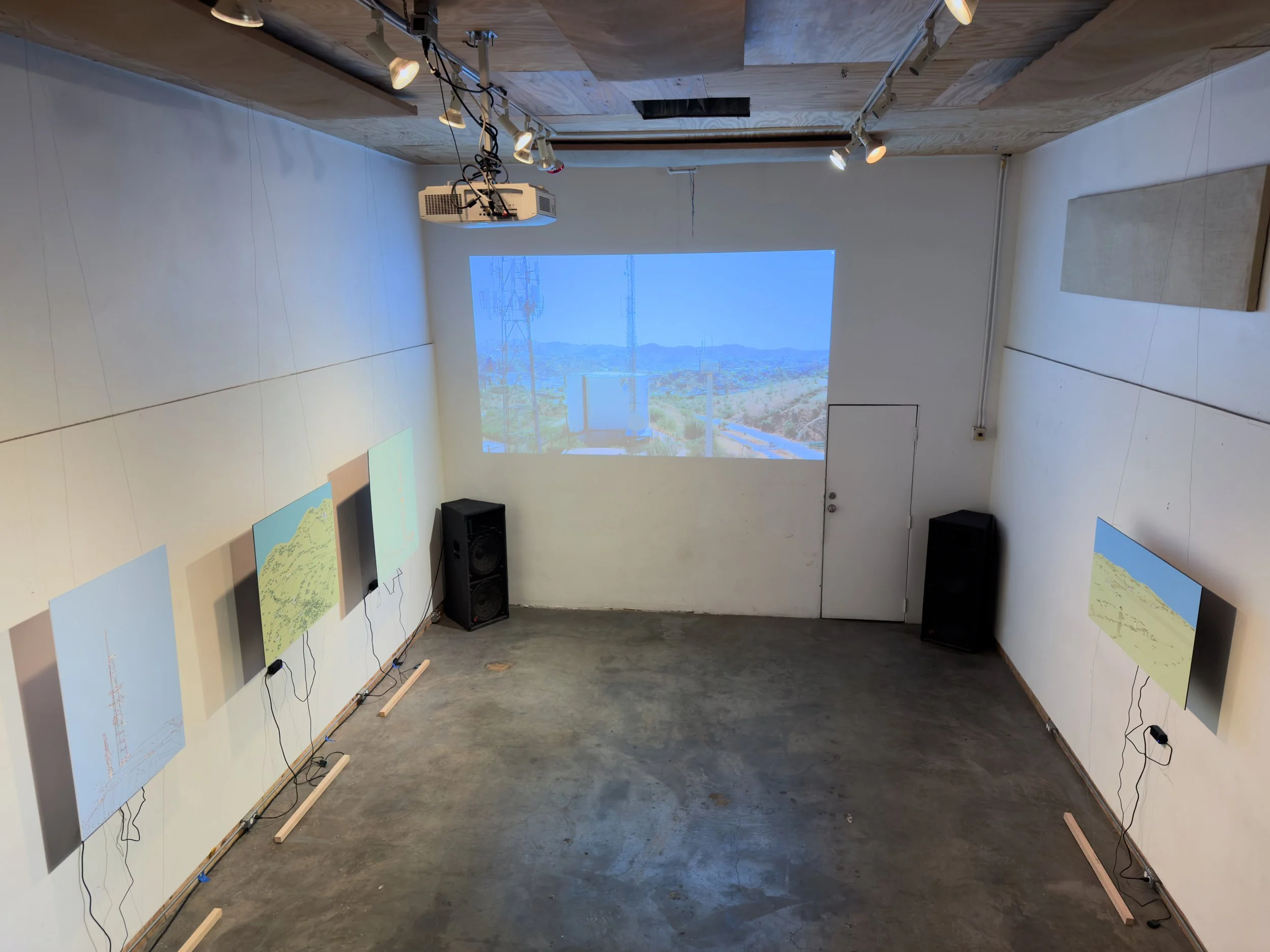
Border Signals Exhibit, Wave Archive, (2025)
Installed at Wave Archive from October 2 to October 19, 2025, Border Signals reconstructed and reimagined, for the gallery space, a site-specific performance in Nogales, Arizona entitled Lines of Flight (2024). The exhibit included drone videography by David Taylor (facing wall), multimedia installation by Robert Henderson (side walls), and a participatory poetry intervention by Johanna Skibsrud (not depicted). My multimedia installation included four digital landscape pieces that imagine the desert awash in digital signals and literally as a signal processing diagram. Each of the four pieces, which hang from ceiling on wire (to facilitate vibration), carry electronics on the back. These vibrate the surface of the piece, turning it into a speaker, which plays the modulated sound described by the diagram on its surface. Combined with the work of Skibsrud and Taylor, Border Signals engages in what I call "imaginative countersurveillance"—an expressive way of seeing that aims to bring into comprehension, which is a form of control, the fact that Tucson Sector of the Arizona includes more than 200 miles of fencing, which "is supplemented by a virtual wall of at least 55 Integrated Fixed Towers—120- to 180-foot surveillance systems equipped with infrared cameras and a built-in radar—mobile surveillance trucks, game cameras, motion sensors, and drones" (Del Valle 2022).
Poet Signal (2025), hires image
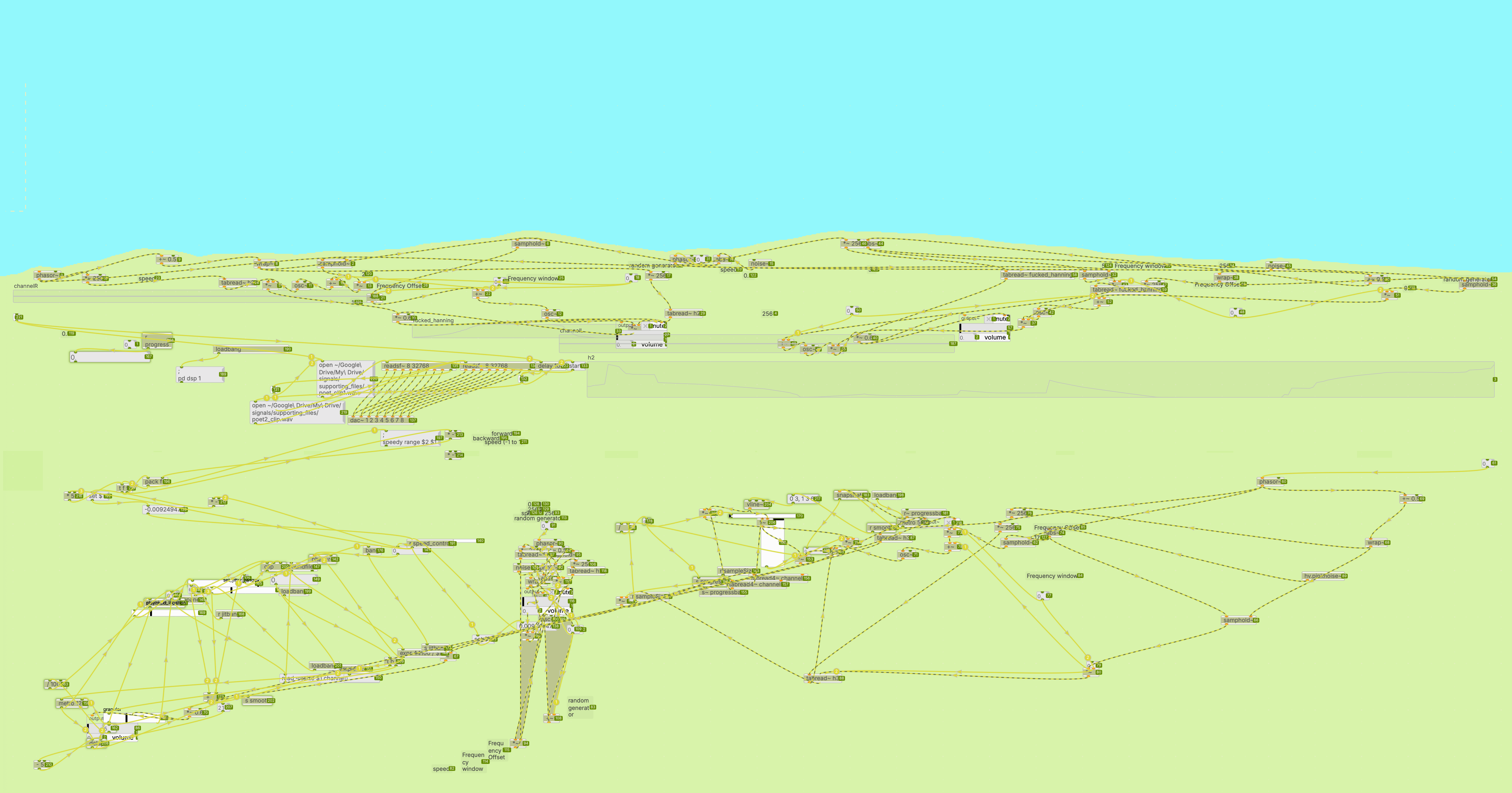
4877x2559px | plugdata and field recording | video. Plugdata is a visual programming language for manipulating audio through signal diagrams. Poet Signal is part of a series of multimedia pieces incorporating field recordings of an audio installation and reading that took place at the Arizona border (see The Ephemeralization Project (2024-), Johanna Skibsrud). It imagines the desert landscape awash in digital signals and literally as a signal processing diagram. (Think, what could I draw by arranging the cables and boxes on the ground at an experimental music performance.) It is a response to living in one of the most surveilled places on earth, where microphones fly overhead and are buried in the earth. We capture what they record, and then play it back in an imagined in-situ.
Tower 2 Signal (2025), hires image
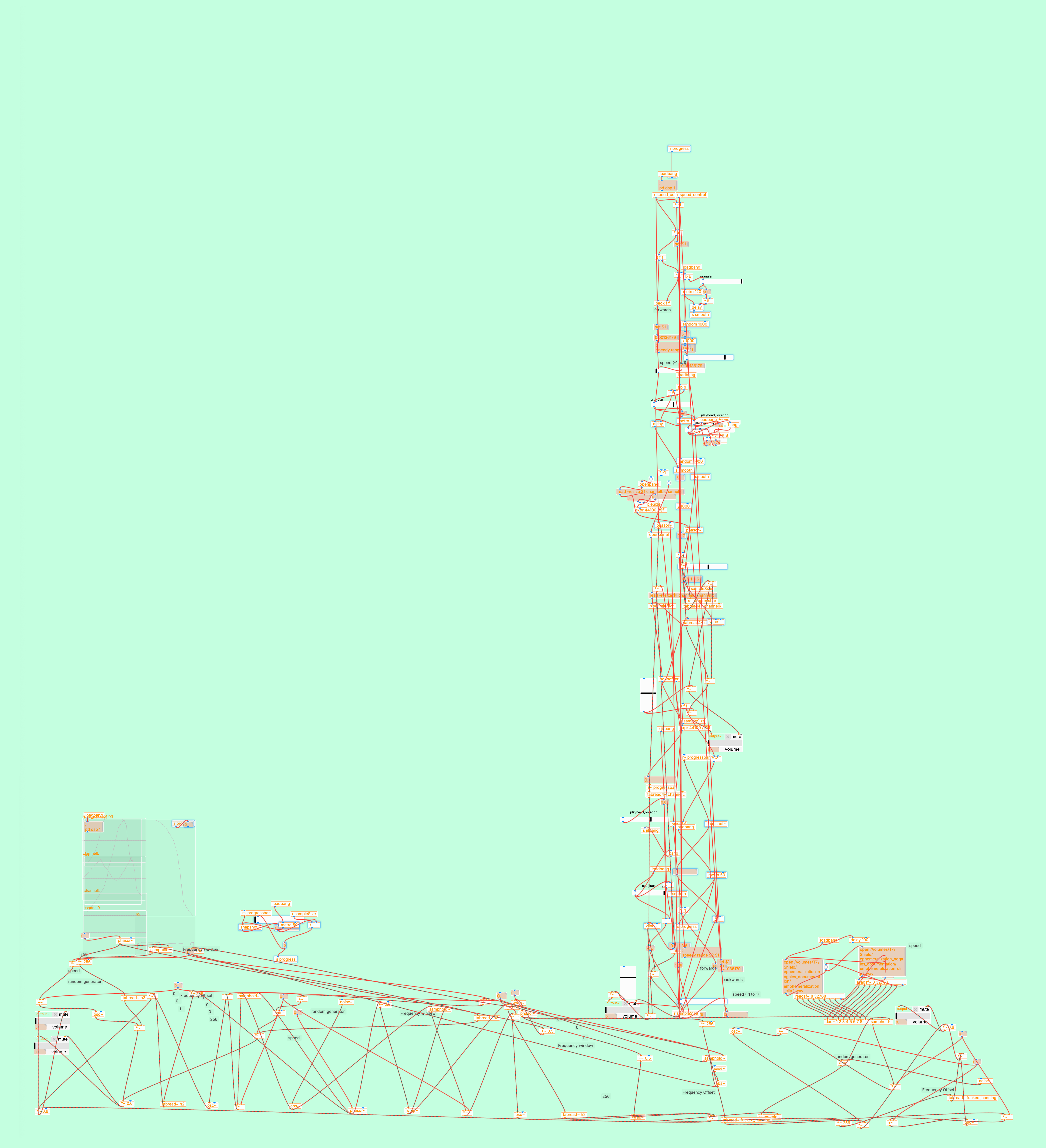
4736x5296px | plugdata and field recording | video. Plugdata is a visual programming language for manipulating audio through signal diagrams. Tower 2 Signal is part of a series of multimedia pieces incorporating field recordings of an audio installation and reading that took place at the Arizona border (see The Ephemeralization Project (2024-), Johanna Skibskrud). It imagines the desert landscape awash in digital signals and literally as a signal processing diagram. (Think, what could I draw by arranging the cables and boxes on the ground at an experimental music performance.) It is a response to living in one of the most surveilled places on earth, where microphones fly overhead and are buried in the earth. We capture what they record, and then play it back in an imagined in-situ.
![Welcome to the Garden of Martian Delights [cover]](assets/martian.jpg)
Welcome to the Garden of Martian Delights [cover] (2025)
9x12 | watercolor and fiber | on paper. In 1924, at the Earth-Mars perihelion, the US Army and Navy collaborated with Charles Francis Jenkins to "listen" for signs of life on the red planet. Astonishingly, strange signals were discovered. In this piece, created in a workshop with Jonathon Keats to celebrate the 75th anniversary of `The Martian Chronicles' at Biosphere 2, I worked with a group of other artists to listen carefully to, and to "translate" the 1924 Jenkins Mars signal anomaly. The result was a book that documents that translation, whose cover is presented here. The book now resides in the Biosphere 2 library permanent collection. Nothing more than the cover will be posted because the true seeker will make a pilgrimage to the Biosphere to read it.
Desert Signal (2025), hires image
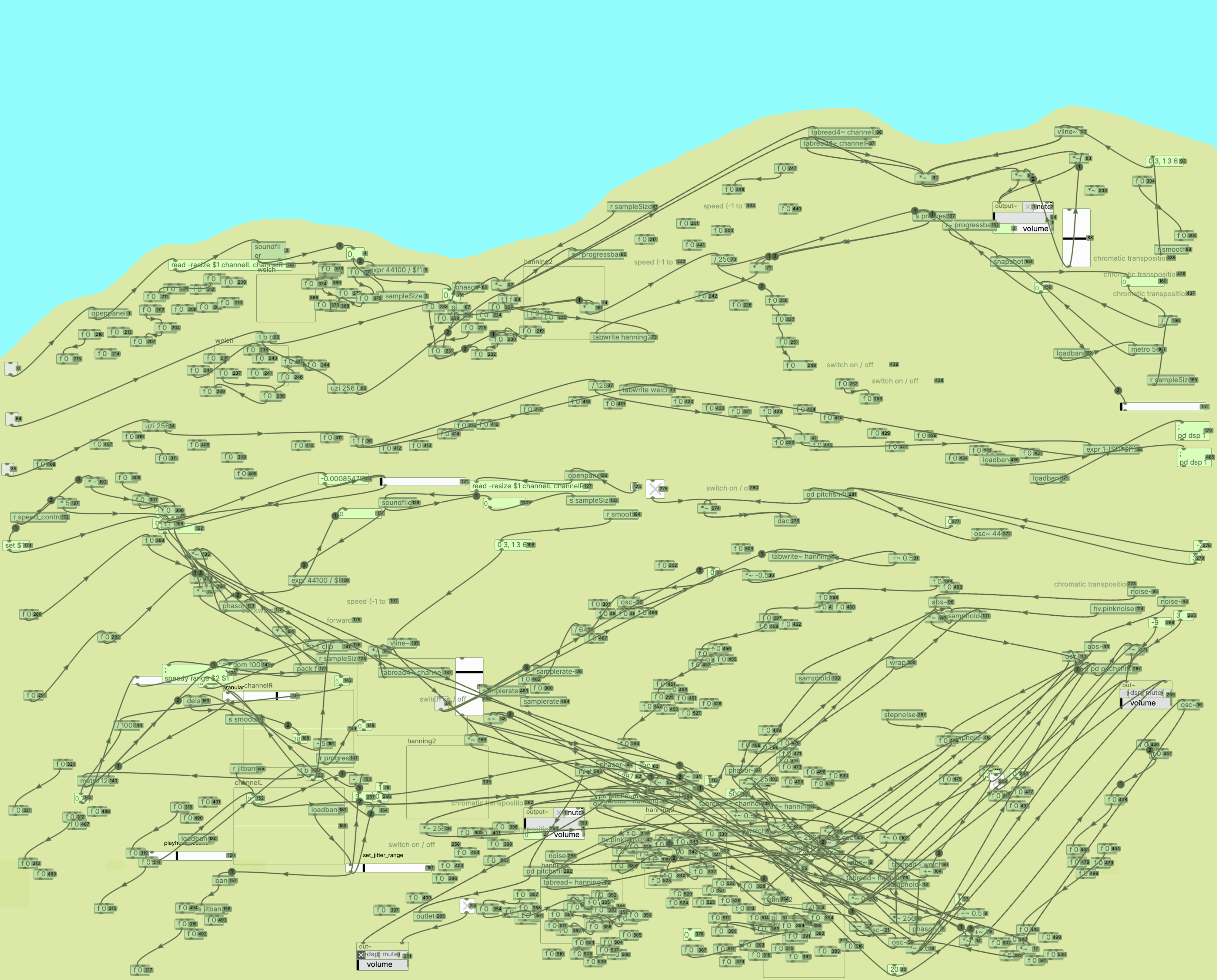
3286x2657px | plugdata and field recording | video. Plugdata is a visual programming language for manipulating audio through signal diagrams. Desert Signal is part of a series of multimedia pieces incorporating field recordings of an audio installation and reading that took place at the Arizona border (see The Ephemeralization Project (2024-), Johanna Skibskrud). It imagines the desert landscape awash in digital signals and literally as a signal processing diagram. (Think, what could I draw by arranging the cables and boxes on the ground at an experimental music performance.) It is a response to living in one of the most surveilled places on earth, where microphones fly overhead and are buried in the earth. We capture what they record, and then play it back in an imagined in-situ.
Tower Signal (2025), hires image
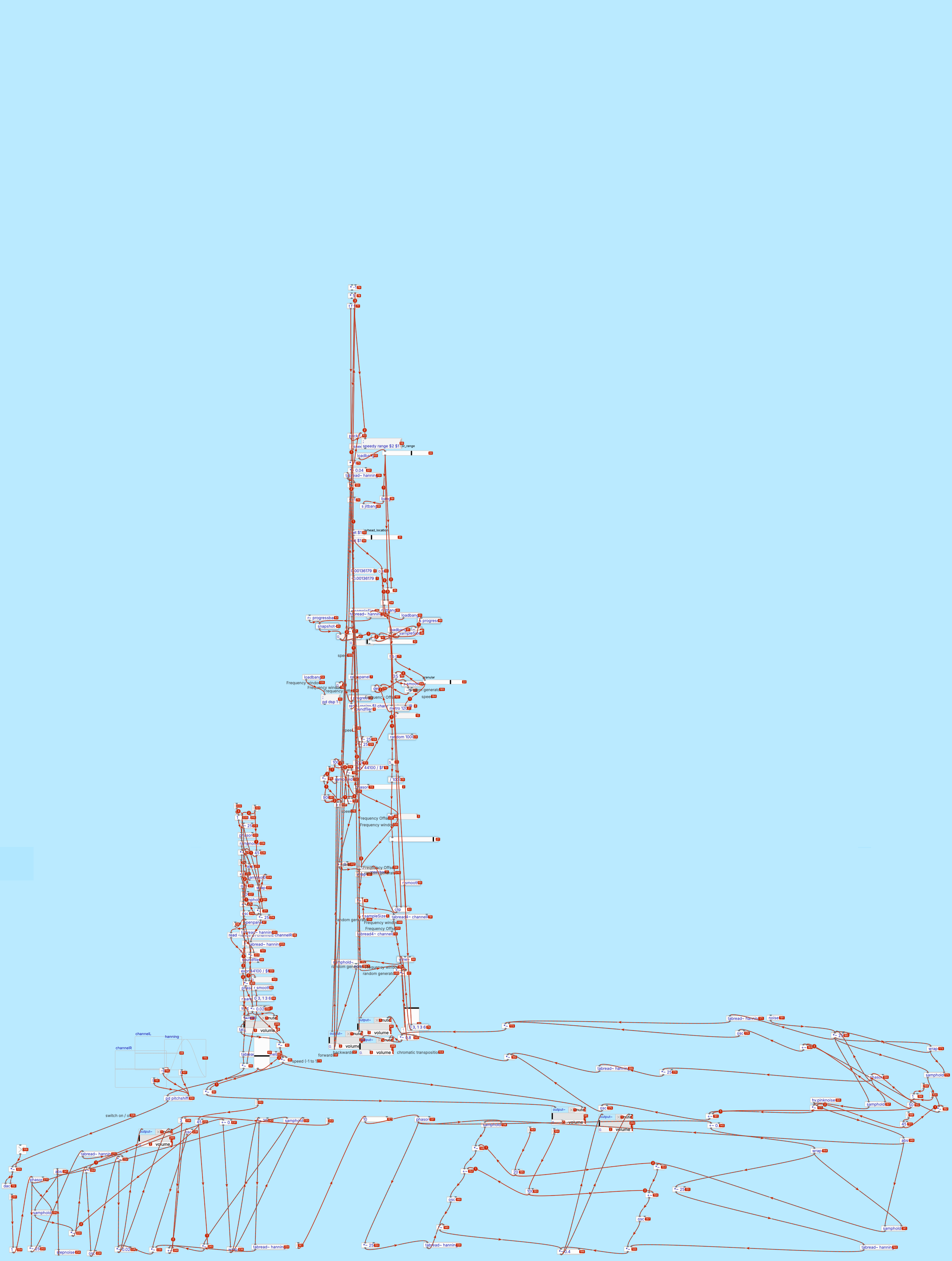
3637x4815px | plugdata and field recording | video. Plugdata is a visual programming language for manipulating audio through signal diagrams. Tower Signal is part of a series of multimedia pieces incorporating field recordings of an audio installation and reading that took place at the Arizona border (see The Ephemeralization Project (2024-), Johanna Skibskrud). It imagines the desert landscape awash in digital signals and literally as a signal processing diagram. (Think, what could I draw by arranging the cables and boxes on the ground at an experimental music performance.) It is a response to living in one of the most surveilled places on earth, where microphones fly overhead and are buried in the earth. We capture what they record, and then play it back in an imagined in-situ.